
Body
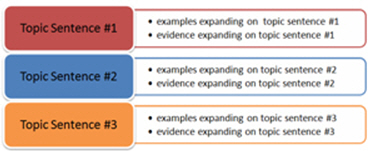 The body expands on and specifies the main idea in the thesis, by creating topic sentences, each of which offers a mini-assertion related directly to the main thesis sentence idea.
Topic Sentence (reason) #1:
Workers need to learn how to deal with change.
Start of the support for topic sentence #1:
Multiple researchers, such as those from enGauge in their report Literacy in the Digital Age (2003), note that workers need to learn how to quickly adapt to changing technology, changing structures in their workplaces, and changing work environments.
This section might continue with additional examples, explanations, and research on rapidly changing technology; rapidly changing work situations, with corporations taking over other corporations and instituting different structures and expectations; and rapidly changing ways of working, including flex time, shared jobs, telecommuting.
Topic Sentence (reason) #2:
Because of dealing with such a rapidly changing work environment, 21st century workers need to learn how to learn.
Start of support for topic sentence #2:
Successful workers in the 21st century need to understand how they, themselves, learn. Some companies offer training in learning styles, and many learning style assessments exist online. In addition to understanding themselves as learners, workers also need to learn how to assess gaps in their knowledge.
This section might continue with additional examples, explanations, and research. It could include case studies showing that companies more frequently retain those workers who can learn, adapt, and upgrade their skills, and it could include interviews with workers who assessed and upgraded their skills.
Topic Sentence (reason) #3:
Most of all, in order to negotiate rapid change and learning, workers in the 21st century need good communication skills.
Start of support for topic sentence #3:
Wertheim (2008) states that “people in organizations typically spend over 75% of their time in an interpersonal situation; thus it is no surprise to find that at the root of a large number of organizational problems is poor communications. Effective communication is an essential component of organizational success whether it is at the interpersonal, intergroup, intragroup, organizational, or external levels” (p. 21).
This section might continue with additional examples, explanations, and research. It could include interviews with Human Resource managers, and it could include data showing the training offered, and thus the importance, that major U.S. companies place on employee communication skills.