
Quality in Art
Wed, Jan 22nd 2014, 22:28
Contributed by Laura Eklund
In his book, “The End of Art,” Arthur Danto suggests that we have entered an age of art without manifestos. He says there is no longer a dominant aesthetic school in Western Art. He points to the moment of Andy Warhol’s stacked Brillo boxes, as the beginning of “The End of Art.” What he means is the end of art without manifestos. In our era of art without “isms,” the question of quality becomes difficult to handle. If there isn’t a dominant standard to use in judging quality of art, how can we ascertain what quality is without a standard?
However, looking at a Rauschenberg ‘Combine’ alongside a painting by Grace Hartigan, you realize that there is such a thing as quality. The “quality” of each work may not be comparable but you cannot deny that the workmanship in both pieces is extraordinary. They are in different aesthetic realms. It may be that in these fractured times; each piece of art sets its own standard by which quality can be measured. If you think of each art piece as a proposal, then each art piece within its own aesthetic confines is setting up the “rules” by which it wants to be judged. The Rauschenberg says it is not trying to be the Mona Lisa or a Caravaggio or a Bill deKooning, but rather is saying, “Judge me by my Own Terms as a Whole, as a Complete Artwork. I am the means to my end.” And that judgment will follow an individualized aesthetic value by whosoever is looking at the piece. That judgment and aesthetic value will be placed in the context of life experience.
Hence, the quality of an artwork is determined on a subjective level.
One of my favorite quotes of an artist is the one I read in a December, 2005 Modern Painters, issue, where Robert Rauschenberg was being interviewed. Basically, I think he summed up the notion on which any artwork can be “judged.” It is actually very simple. I find it a very powerful, simple, and honest truth; one that which I honor and hold belief in as an artist.
“If it doesn’t change your life, it’s not art.” --- Robert Rauschenberg
How can I tell if I am looking at a great piece of artwork? I will be pulled in, stunned with directness, an immediacy that breaks down all my resistance. It is like the experience of theatre or music. You can feel it. You become completely involved in it, swept away. It becomes your reality. This becomes and is transformed into “experience.” Experience comes from aesthetic, emotional, spiritual, and intellectual realms. If you can experience an artwork and become involved, if it is that powerful, then, in my opinion, you are beholding a great piece of artwork.
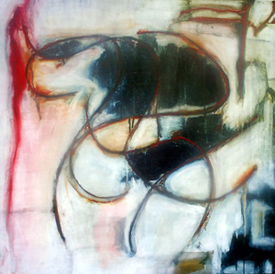
I will talk of my experience some. When looking at great pieces of artwork, for instance, an El Greco, a Rembrandt, a Pollock, Edvard Munch, a DeKooning, a Rauschenberg, a Miro’, I have had many different reactions. Great art has made me feel lots of things. Pollock’s Autumn Rhythm has made me sob and moan. Great artworks have made me happy, ecstatic, pissed off, depressed and sad. Great artworks, “masterpieces” have engraved my brain and even given me nightmares. Great artworks have inspired me to want to contribute my own entity into the conversation and to bring what gifts I have into the world. Great artworks can, and do change your life.