Avoiding Plagiarism
Wed, Jan 22nd 2014, 22:33
Contributed by Claire Bradin Siskin – All writing instructors sooner or later must grapple with the issue of plagiarism, and the problem is particularly acute for those who teach English Language Learners (ELLs). An online tutorial called “Avoiding Plagiarism” has been developed. It is one component of the English as a Second Language Writing Online Workshop (ESL-WOW). ESL-WOW is funded by a grant from the Fund for the Improvement of Postsecondary Education (FIPSE) of the U.S. Department of Education. The project is sponsored by Excelsior College in Albany, NY.
“Avoiding Plagiarism” is designed to help college-level students understand what plagiarism is in the context of higher education in the United States, how plagiarism is detected, what the consequences might be, and, most importantly, how to avoid it. The focus is positive and practical.
In the “Welcome” section, the objectives are stated, and there is an optional quiz and introductory video. In the video, a student who has been notified that “unoriginal” text was detected in her work discusses the situation with a college administrator and finds out what her options are.

In the next section, “What is Plagiarism?” plagiarism is defined, and seven different types of plagiarism are listed. An example is given for each type.
|
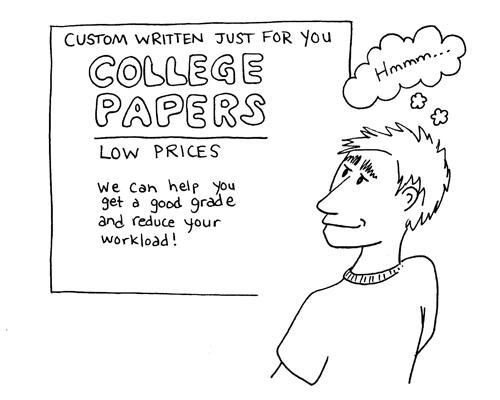
Example 3: You pay another person or company for writing that you submit as your own writing. |
|
In the “Consequences” section, the various outcomes of having plagiarized are given, such as being required to do the assignment again, receiving a zero on the assignment, or failing the course. Under “But in My “Country…” there is a discussion of American attitudes about plagiarism and the ownership of words. It is acknowledged that using others’ words may be viewed very differently in other countries, where in fact it may be seen as a sign of honor and respect. It is also recognized that plagiarism is a serious problem for American students as well as for international students.
The longest and most important section of the tutorial is “How to Avoid Plagiarism.” In a second video, the student and her professor discuss paraphrasing, summarizing, and correct citation.

A menu of choices includes how to cite sources, method of citation, and style of citation, paraphrasing, summarizing, and note-taking. A discussion of “common knowledge” refers to information that does not require citation. Numerous examples of appropriately summarized and paraphrased passages are provided as models, along with several interactive exercises. The “Test Your Knowledge” section includes a general quiz as well as an activity that asks students to examine various sentences and decide whether or not they need a citation. Additional resources include a glossary and links to YouTube videos about plagiarism.
More information is available at http://eslwow.org. All of the materials in ESL-WOW will available free of charge to the public by the end of 2012. If you would to be included on an email distribution list to receive occasional announcements about the project, please send your name, affiliation, and email address to info@eslwow.org.